Guidelines for submitting articles to Mazarron Murcia
Hello, and thank you for choosing Mazarron Murcia to publicise your organisation’s info or event.
Mazarron Murcia is a website set up by Murcia Today specifically for residents of the urbanisation in Southwest Murcia, providing news and information on what’s happening in the local area, which is the largest English-speaking expat area in the Region of Murcia.
When submitting text to be included on Mazarron Murcia, please abide by the following guidelines so we can upload your article as swiftly as possible:
Send an email to editor@spaintodayonline.com or contact@murciatoday.com
Attach the information in a Word Document or Google Doc
Include all relevant points, including:
Who is the organisation running the event?
Where is it happening?
When?
How much does it cost?
Is it necessary to book beforehand, or can people just show up on the day?
…but try not to exceed 300 words
Also attach a photo to illustrate your article, no more than 100kb
PROPERTY SEARCH
article_detail
Date Published: 18/05/2026
Andalucía election results 2026: PP wins again, but will have to join Vox coalition
The centre-left lost out badly in these elections, while smaller far-left and independence parties are growing in their place
This weekend, the autonomous community of Andalucía went to the polls to choose who would lead the region’s governing Junta for the next four years.
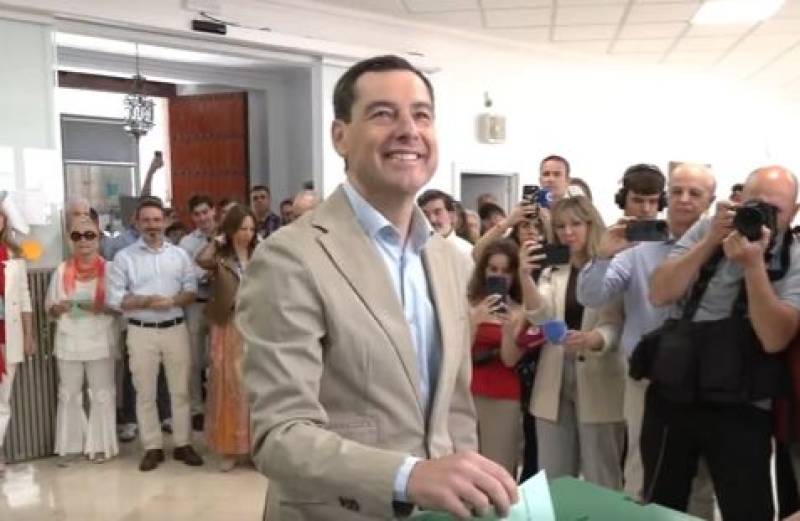
In a result that surprised nobody, the incumbent conservative PP party, led by Juanma Moreno (pictured, above), won the most votes but this time lost their absolute majority, meaning they will now have to form a coalition government.
The most likely coalition partner for the PP is the far-right Vox party, which gained seats in the regional government in this election.
An absolute majority in the Junta de Andalucía requires 55 seats, whereas the PP got 53, losing five.
The other major party, the socialist PSOE – whose Pedro Sánchez is the head of the national government in Madrid – lost spectacularly. They secured only 28 seats, winning just 22.7% of the total votes – around half what the PP got.
That’s two fewer seats than they won in 2022. The PSOE candidate for regional president, María Jesús Montero, is the Deputy Secretary General of the PSOE, the party’s number two, and until this March was the First Vice President of the Government under Pedro Sánchez.
She left that post to try to win the presidency of Andalucía, a gamble that has not paid off for the PSOE in a region that, traditionally, according to its rustic, peasant roots, should be a leftwing stronghold but no longer is by any stretch of the imagination.
Rising minor parties
Other leftwing parties got more votes than Vox, but because they were split between two different parties, they fell behind the far right in the number of regional representatives and were not able to challenge them.
Adelante Andalucía was the real surprise of these elections, quadrupling its representation in the Andalusian Assembly and sending eight pro-independence deputies to the senate after obtaining more than 400,000 votes, 9.6% of the total.
Its leader José Ignacio García (pictured above, second from right) was one of the big winners of the night, and Adelante, with its Andalusianist rhetoric, is consolidating its position as the leader of the Andalusian alternative left.
The other leftist party, Por Andalucía, headed by the federal leader of the Izquierda Unida (United Left), Antonio Maíllo, won five seats, more than 260,000 votes, and 6.3% of the popular vote.
It maintains its own parliamentary group, something that was not guaranteed during the count, and manages to salvage its position.
Vox has gained one more seat than in 2022, bringing the total number of far-right deputies to 15 in the Andalusian Parliament this term. Led by Manuel Gaviria obtained 13.8% of the vote, more than 575,000 ballots. Four years ago, Vox obtained 496,618 votes, 13.47% of the total, which allowed them to secure 14 seats.
The other far-right candidates, Se Acabó La Fiesta (The Party’s Over), failed to gain any seats in Parliament, only garnering 103,402 votes, 2.5% of the total.
While it would be a mistake to read too much into this regional election as a reflection of what could happen in a national general election – which is due to take place in Spain in 2027 – it is representative of the kind of political fractioning that is becoming more common and the rise of smaller, marginal parties as kingmakers in the electoral game.
Some people see this as a negative, the loss of traditional political structures meaning that there is never a clear, strong leader who can fulfil their election promises without watering them down. However, this type of coalition system does have the advantage of forcing negotiation and cooperation between different political factions, ensuring (in theory, at least) a more broadly inclusive and representational form of democracy.
Breakdown by province
The province of Huelva distributed 11 regional parliamentary seats as follows: five for the PP (41%), three for the PSOE (25.2%), two for Vox (15%), and one for Adelante Andalucía (8%).
Seville has 18 representatives in Parliament. Eight of them went to the PP (39.3%), five to the PSOE (24%), two to Adelante (13%), which finished ahead of Vox (10.7%) in this province, although they also won two seats, and one to Por Andalucía (7.5%).
The province of Cádiz has 15 representatives. Seven of them went to the PP (39%), three to the PSOE (20.1%), two to Adelante Andalucía (14.3%), two to Vox (13%), and one to Por Andalucía (5.3%).
The 17 representatives from Málaga are distributed as follows: nine seats for the PP (44%), four for the PSOE (20%), two for Vox (14.5%), one for Adelante Andalucía (9.3%), and one for Por Andalucía (6%).
Six of the 12 seats in Córdoba went to the PP (43.2%), three to the PSOE (22.2%), one to Vox (12.6%), one to Por Andalucía (8.8%), and one to Adelante (8.4%).
Jaén has 11 seats, six of which went to the PP (43.8%), four to the PSOE (27.3%), and one to Vox (13.5%).
Of the 13 seats in Granada, six went to the PP (42.5%), three to the PSOE (24.2%), two to Vox (15%), one to Adelante (6.8%), and one to Por Andalucía (6.4%).
Finally, the province of Almería, where Vox has overtaken the PSOE, has 12 seats up for grabs: six for the PP (42.9%), three for Vox (23.2%), and three for the PSOE (21.5%).