Date Published: 12/03/2026
What would happen if a plane crashed at Corvera Airport? Emergency services carry out drill to prepare for the worst case scenario
ARCHIVED ARTICLE -
A dramatic mock plane crash this Thursday was designed to test how emergency services in the Region of Murcia would respond if the worst really happened
What looked at first glance like a serious air disaster at the
Region of Murcia International Airport this Thursday morning, March 12, was, fortunately, in reality a carefully planned training exercise.
Airport authorities staged a full-scale emergency drill designed to test how different services would respond if a major aviation accident occurred. The exercise forms part of the airport’s emergency preparedness obligations under the regulations of the International Civil Aviation Organization and the airport’s own self-protection plan.
The simulated scenario was dramatic by design. A Boeing 737-800 aircraft carrying 125 people, including 120 passengers and five crew members, was imagined to have lost altitude while beginning its landing manoeuvre. According to the scenario, the aircraft was forced to make an emergency landing outside the airport perimeter near runway 23. The fictional crash resulted in multiple injuries and several fatalities.
This is not the first time airport staff have carried out such a drill, the last one being
in March of 2024.
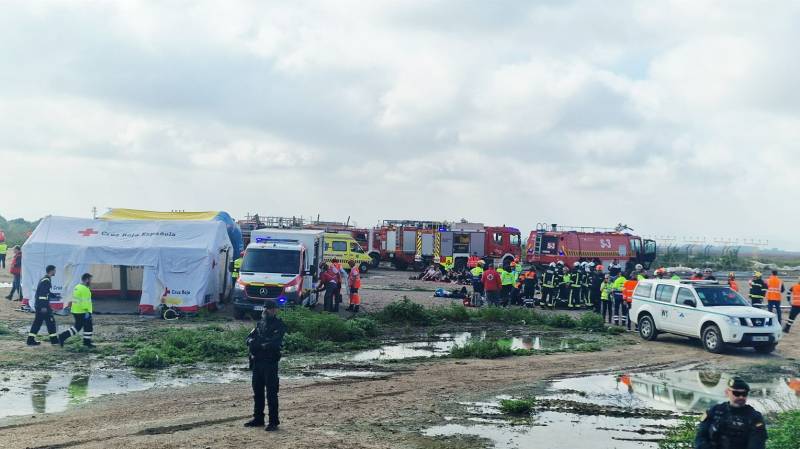
This week’s exercise began when the airport control tower “detected” the accident and alerted the airport’s Operations Centre. Rescue and firefighting teams based at the airport were among the first to reach the scene.
Because the simulated accident was classified as severe, the airport declared a general emergency and requested support from external services. That triggered the activation of the Region of Murcia’s territorial civil protection plan, known as PLATEMUR.
From that moment, the full emergency response chain was set in motion. Members of the Guardia Civil and the Policía Local de Murcia joined the operation, alongside firefighters from the Murcia Fire and Rescue Service. Medical teams were also deployed, including personnel and ambulances from the Servicio de Emergencias 061, Civil Protection volunteers and the Spanish Red Cross.
Coordination of the various teams was handled by CECARM 112, which managed operations from both the main command post and an advanced command post closer to the simulated accident site.
To make the situation as realistic as possible, dozens of volunteers acted as injured passengers. Students and trainees from several regional training centres took part, playing victims with different types of injuries and requiring treatment and evacuation.
Another key element of the exercise took place inside the terminal building. Because the scenario simulated a major air accident, the airport activated its Family Room, a space designed to receive and support relatives of passengers and crew.
Separate areas were established for families of passengers and for relatives of crew members. Actors from the psychology and nursing faculties at UCAM Universidad Católica de Murcia and from the XTART training centre portrayed distressed family members with varying levels of anxiety. Their role was to test how staff would provide information and psychosocial support during a crisis.
In total, around 400 people participated in the large-scale simulation.
Image: Aena
article_detail

|
Read more articles about Corvera Airport, Murcia